Laura's Birding Blog
For the love, understanding, and protection of birds
Friday, March 16, 2012
Archimedes!
Eagles!
(Transcript of today's For the Birds)
Right now we’re at the peak of eagle migration over Duluth. The crows in my neighborhood have been making a ruckus whenever eagles pass over, but they make a ruckus for everything else, too. This year’s eagle migration has been impressive, based on all the phone calls and emails I’ve been getting from people seeing them flying overhead. A lot of people are surprised to see them circling over parking lots, but when snow was covering the ground, roads and parking areas were the best places for thermal air currents to form. Now that the snow is melting again, thermals can form just about anywhere.
Frank Nicoletti and several other birders have been counting eagles along Skyline Parkway: the biggest days so far were March 11, when they counted 400 Bald Eagles, 21 Golden Eagles, and 16 Rough-legged Hawks, March 13, when they had 341 Bald Eagles, 5 Goldens, and 12 Rough-legs, and March 15, when they had 451 Bald Eagles, 28 Golden Eagles, and 12 Rough-legs. Other hawks are also coming through, though not in those numbers yet. The peak of migration for eagles usually falls sometime around March 25. Rough-legs and Red-tailed Hawks tend to peak in mid-April, and Broad-wings in early May, so there will be plenty of good hawk viewing in the coming weeks. (You can learn more about the count here.)
Many migrating eagles are headed to the far north. Eagles nesting in Florida and other Gulf Coast states started as early as late fall and many are already done for the year. Those nesting at our latitude started nesting in the past couple of weeks. Eagles reuse the same nest year after year, making some repairs in fall after their young are independent, and then making more repairs on the nest in spring before the first egg is laid. Eagle pairs usually mate for life, but we don’t know much about whether they spend the winter together except non-migratory pairs—at least some of them stay together all the time. Some mating behaviors are documented on wintering grounds, so some ornithologists believe that at least some eagle pairs may remain together year-round, but it would take long-term tracking of marked individuals to figure out for sure how often this happens.
Duluth East High School may be unique in the Lower 48 as a large public high school with an active Bald Eagle nest right on the school grounds, easily viewed from the parking lot or the athletic fields. The pair has returned there year after year since the school was a junior high school, and throughout construction when the building was rebuilt as a high school. I went on a bird walk around the school with some of Jenny Madole’s students on the Ides of March, and the highlight was seeing one of the eagles on the nest. The bird was sitting tight. She looked directly at us for a while, but I could also see her watching crows flying over, and also looking out in directions where I couldn’t see anything in particular, but she didn’t move the rest of her body at all. It takes about 35 days for the eggs to hatch, so students should be seeing fuzzy little heads peeking out in April, and the eaglets should be getting big enough to sit higher up by the end of the school year. It’s hard for the kids to be so near and yet not know for sure what’s going on inside that deep nest. Some students are investigating the possibility of getting a nest cam for next year—that would be a splendid learning opportunity for the entire community. Meanwhile, the kids are piecing together the eagles’ family life with glimpses of the birds as they can, while they plan out bird feeders and nest boxes to make East High School an even more extraordinary place of learning that will truly be for the birds.
Thursday, March 15, 2012
Robins
Back in early February, I saw an American Robin in my backyard. Part of the time he was eating berries, and part of the time he was rummaging through leaves in the back of the yard for earthworms. This may have looked like a little preview of spring, but it didn’t sound like it—he wasn’t singing yet. Some robins spend the entire winter in Duluth, not due to climate change directly, but because they wander widely, wherever they can find berries and crabapples. The ones wintering here aren’t necessarily the same ones that will breed here, but robins that winter in the northern tier of states and in Canada do have the advantage of a shorter distance to travel to their breeding grounds, assuming they survive the winter. Males that winter further south have the energy expense and dangers of long-distance travel, but they don’t deal with severe cold. Weather patterns change from year to year, and robins that have the advantage one year may not the next. In the long run, climate change may have increasing advantages for robins wintering in the north, because the South is having more tornado-level storms in winter, while the North is having milder winters. But as long as there are huge amounts of fruit in the South, we’ll almost certainly continue to have robins wintering throughout their range for the foreseeable future.
Wherever they are outside the breeding season, robins are constantly on the move, but the bulk of robin migration northward in late February and March follows the 37-degree isotherm. With the current warm front, we can expect robins to start appearing throughout the north woods in the coming days. I always get a surge of joy when I hear my first one. Considering how variable the weather can be in early spring, it’s cool that once our first spring robin appears, he sings day after day, whatever the weather brings, including heavy snow and ice storms.
Female robins return a couple of weeks after the first males. By then, territorial disputes are mostly settled, and females can get down to the business of nesting. Few robins in towns nest in trees anymore—their eggs and nestlings are just too vulnerable to the burgeoning numbers of urban crows. Those robins who still do nest in trees invariably choose a thick evergreen for their first nest, since they lay their first eggs before leaves have emerged enough to provide protection from sun and rain in deciduous trees. More and more robins nest on houses and other structures close enough to people to get some safety from the crows. Most people enjoy their backyard robins, but when they nest on a porch light or something else right by an entry, the robins may make a mess, start dive-bombing us, or make us worry about disturbing them. Setting out robin nest platforms in more desirable places on the house can help both us and them. Carrol Henderson’s book, Woodworking for Wildlife, available in bookstores and from the Minnesota DNR, has excellent plans and advice for placing robin nest platforms.
Few researchers focus on robins in banding studies. Those adults who are successful breeding in an area may return for several years straight—the oldest wild robin known lived to be almost 14 years old—but their young seldom return anywhere near where they were raised, and individual robins seldom return year after year to particular wintering areas, so their movements are still not at all understood. I love how a homey backyard bird that just about everyone notices and recognizes can keep so many secrets from us.
Birding with the Flu
Four weeks ago, I came down with the flu. This year’s virus strain is a doozy—every time I thought it was actually clearing up, I got sick all over again, which is not a good thing for a person who makes her living mostly by out-of-town public speaking. I had several engagements, each of which came up right when I thought I was getting better, and after each one, I ended up sicker than before. I came home from the last one with a full-blown infection—fortunately, I could feel it coming on and got to the doctor while the fever was still low, but it climbed all day and into the night before it finally broke due to the antibiotics. Now I can finally talk for a few minutes straight before I break down into coughing again.
Overall, this wasn’t that big a deal, because lucky for me, I’m a human. Birds don’t have the luxury of being able to hunker down and watch romantic comedies and funny Leslie Neilson DVDs when they’re sick. Even the most wonderfully paired cranes can’t rely on their mate to prepare chicken soup, and if the weather is uncomfortably cold and wet and you happen to be a bird, well, that’s just too bad. If a bird is too sick to spend all its waking hours finding food and detecting potential predators, it simply won’t survive.
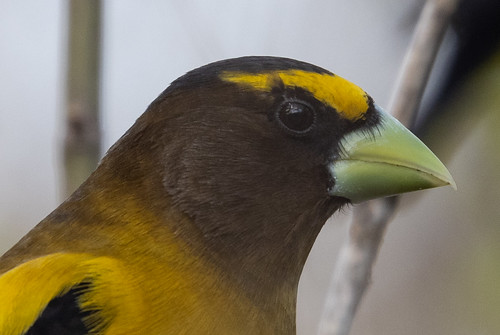
The engagements I did while I was sick included leading a couple of field trips at the Sax-Zim Bog, one for the Sax-Zim bird festival and one for Duluth Audubon. A Great Gray Owl has been hanging around, but hasn’t been very cooperative and never seems to be hunting anywhere near a road, so seeing this one involves not just luck but a good hike. But Boreal Chickadees, Gray Jays, Evening Grosbeaks, and Common Redpolls have been fairly easy to see all winter at the bog, and even when I was feeling sick, I couldn’t help but take photos of them.
Canal Park in Duluth has also been superb, with six species of gulls still turning up fairly regularly, including not just the regular Herring but a few overwintering Ring-bills, several Glaucous, a few Iceland and Thayer’s, and even one or two Great Black-backed Gulls. I’ve managed to get photos of all six species even though I’ve only been to Canal Park three times all season.
These gulls spend part of the day by the Superior landfill and part by the Western Lake Superior Sanitary District facility. Unfortunately, some birders were stopping by WLSSD even though it’s closed to the public for obvious safety reasons, and despite the fact that it’s much simpler to just head to Canal Park in mid- to late-afternoon, when the birds take a break from sewage and garbage to loaf around near the lift bridge. Several birders have been feeding them bread there all winter, making the gulls’ regular visitors at Canal Park, where they are extremely easy to see. Common Goldeneyes are hanging out in several areas in the Lake, and are now doing their cool breeding displays. The males bob and suddenly jerk their head all the way to their lower back, bill pointed skyward. That’s one of the coolest, most thrilling breeding displays I’ve ever seen, and right now when you find a flock, it’s almost certain that at least some of the males will be doing this.
Goldeneyes have been here all winter, but Hooded Mergansers are also starting to show up, the males making their breeding displays by bobbing their heads and raising and lowering their elegant crests. Even when I’ve been stuck home in bed, I’ve been able to see dozens and sometimes hundreds of winter finches and my own dear chickadees, but I’m glad I’m getting well in time to enjoy spring migration at its finest.
Monday, March 12, 2012
Daylight Savings Time
(Transcript of today's For the Birds)
This past weekend was the shortest weekend of the year for most Americans, thanks to Daylight Savings Time—one of the oddest inventions people have come up with since cuckoo clocks. When I was helping count raptors at Hawk Ridge and was counting all migrating birds along the North Shore during the 1980s and 90s, we always used Standard Time on our data sheets—we called that “Bird Time,” since birds don’t change their clocks at all, but really, birds don’t use any clock system. True bird time would use sunrise and sunset as references, and the number of daytime and nighttime hours, and thus the actual time, would change daily throughout the year.
The concept of Daylight Savings Time is often credited to Ben Franklin, who did mention it in 1784. But the modern idea of daylight saving was first proposed in 1895 by George Vernon Hudson, and it was first implemented during World War I. Germany adopted it first, on May 1, 1916. The rest of Europe adopted it as the war progressed, and the US adopted the Standard Time Act in early 1918—that year, Daylight Savings Time started on March 31, but it was so unpopular that Congress abolished it after the war. Roosevelt instituted year-round Daylight Savings Time, which he called War Time, on February 9, 1942; it lasted until the last Sunday in September in 1945.
In 1946, many states and localities started using summer Daylight Savings Time. This caused great difficulties for the transportation industry because of bus, train, and airline schedules, so in 1966, Congress adopted the Uniform Time Act, mandating Standard Time within the already-established time zones, and provided for Daylight Savings Time to begin at 2 am on the last Sunday of April and to end at 2 am on the last Sunday of October. States were allowed to exempt themselves from Daylight Savings Time only if the entire state did so, and every state that did adopt DST was required to begin and end on the established dates. The first two states to exempt themselves from Daylight Savings Time were Arizona and Michigan. The Department of Transportation is still the governmental agency in charge of regulating time zones and Daylight Savings Time. The law was amended in 1972 to allow states with split time zones to exempt either the entire state or the part of the state on a different time zone.
Energy savings statistics from Daylight Savings Time are sketchy. In 1986, Congress amended the Standard Time Act to begin Daylight Savings Time on the first Sunday of April. The Energy Policy Act of 2005 extended Daylight Savings Time to the second Sunday of March, ending it on the first Sunday of November. Some congressmen advocated the continuation into November specifically so children could have another hour of daylight for trick-or-treating.
From 1970 until 2006, most of Indiana did not observe daylight saving time, but the entire state started to do so in April 2006 after eight counties in western Indiana were shifted from the Eastern Time Zone to the Central Time Zone. Arizona had rejected Daylight Savings Time in 1967, mainly on energy conservation grounds, because an extra hour of daylight after working hours meant that people coming home from work operated their air conditioning an hour longer each day. The main electrical savings comes from residential lighting in early evening. A 2008 study examined electricity billing data in Indiana before and after it adopted DST in 2006, and concluded that DST increased overall residential electricity consumption by 1–4 percent, due mostly to extra afternoon cooling and extra morning heating; the main increases came in the fall.
Birds pay no attention to the our clocks, and people who like to go birding in the morning before heading to work resent losing that precious hour of daylight when it really matters. But people who don’t mind leaving for work in the dark as long as they can enjoy some light after work seem to like it. But like most things, Daylight Savings Time is what it is, and those of us not in Arizona or Hawaii are stuck with it for at least another 8 months.
Friday, February 17, 2012
Wind Turbine Proposal in Watersmeet, MI
Every spring, I spend as much time as possible in northern Wisconsin and Michigan's Upper Peninsula, especially along the South Shore of Lake Superior. Birds headed north get stopped by this, the largest lake in the world, and flood along the shoreline in huge numbers. The quality of birding is amazing. And every summer I spend a week in Eagle River, Wisconsin, teaching an elderhostel birding class. Eagle River is not far from the state line, and our trips cover areas in both Wisconsin and Michigan. People come from all over to go birding in some of the loveliest habitat in the country. The wealth of warblers alone is outstanding—in much of the eastern United States, people get to see most of these species only for a few weeks during spring migration, but we get to enjoy them all summer—warblers know that the North Woods is the right place to raise their young.
We still have a very high quality of life up here compared with many places in the United States. Looking down from a window seat in an airplane wherever I’m flying, I can’t see a single panoramic view that isn't crisscrossed by highways and broken up into a patchwork that always includes residential areas and agricultural fields. People and the changes we've made are everywhere. Even when flying along the edge of the Boundary Waters Canoe Wilderness Area in Minnesota or the Sylvania Wilderness in Wisconsin, we can’t help but notice that the wilderness is quite small when seen from above, surrounded by roads, houses, and commercial enterprises.
Geographers make animated gifs showing the spread of people of European origin from the 13 colonies through the rest of what is now the United States, decade by decade, using census data. It frightens me how filled in the map now is—how people have encroached on every single place so that the only ostensibly wild spaces remaining are densely surrounded by people whose activities year by year change the character of this wildness. The change is especially noticeable in areas that once had extremely low human population density, such as the counties surrounding Lake Superior. The human density here is still much lower than in most of the United States, but the trend is clear.
“To whom much has been given, much is expected.” Whether we take our quotes and lessons from Luke's Gospel in the Bible or from John F. Kennedy’s speeches, this simple sentiment has a lot of resonance for many of us. It seems to me that those of us who live in areas where our wonderful quality of life results from the relatively natural character of our surroundings have an essential obligation to do what we can to protect and preserve that natural character as much as possible. We clearly have obligations to our own species as well as nature, but protecting the wild character of our environment benefits us as well as wildlife, ensuring the quality of our water and air and the lovely wild sights and sounds that so many of us require for soul-deep satisfaction in our daily lives.
Right now, the Township of Watersmeet is considering whether to give a permit for one landowner to construct a large wind turbine on the shore of Thousand Island Lake. I am a strong proponent of wind energy and other clean alternatives to burning fossil fuels. I’ve seen wind farms that seem perfectly sited, like two I’ve photographed that are located in corn fields in Illinois and Indiana.
I’d love to see energy-generating wind turbines in medians along thousands of miles of our interstate highways, too. These kinds of areas are among the worst habitats for wildlife and also have low quality scenic value for people, so seem like exactly the right places for wind turbines. But tragically, the places people are most focused on constructing turbines are in the worst possible locations as far as their potential impact on wildlife—along shorelines, coasts, and mountain ranges where habitat may still be good and where migration is known to be heavy.
There is abundant evidence that these structures are dangerous for birds. Diurnal birds such as hawks have been killed in large numbers in collisions with turbines, but people have learned that building the supporting structure as a solid tower rather than as a lattice can at least reduce the numbers of hawks killed.
Any structure directly in the flight path of night-flying migratory birds can kill them, and structures tall enough to require FAA lighting to protect nearby airplanes actually draw in night-flying birds to greatly exacerbate the problem. In a single night last fall, 484 birds perished in collisions with a West Virginia mountaintop wind energy facility. Most of the birds were Blackpoll Warblers—a vulnerable species on many conservation watch lists.
Unfortunately, the impacts of wind technology on wildlife haven’t been tested on wide scales. In every known case where wind turbines have killed large numbers of birds, the wind industry has testified that the kill was a local phenomenon that would not be repeated again or elsewhere. The US Fish and Wildlife Service is greatly limited in advising against projects until they have long-term data establishing beyond the shadow of a doubt that a project will cause serious problems, and they simply do not have the funding or public mandate to do the kinds of testing necessary to prove how serious these dangers are, even though a great many studies and individual cases have shown conclusively that birds are killed by them, sometimes in large numbers. Even after millions of birds had been shown to be killed at communications towers every year, the US Fish and Wildlife Service has never been able to regulate them beyond making non-mandatory recommendations as outlined at http://www.fws.gov/habitatconservation/communicationtowers.html (Many of the guidelines provided by US Fish and Wildlife for communications towers are relevant for wind turbines.)
Tragically, air pressure changes within moving turbines are associated with unsustainably high numbers of bat kills. Bats are suffering from a huge array of problems right now, and so until research can find ways of minimizing their deaths at towers, it seems simply irresponsible to add to the crisis. In our day-to-day lives, we notice birds a lot more than bats, and so a lot of people dismiss bat deaths as relatively unimportant, but bats are essential for controlling flying insects. Their role in pollination is far more critical in the tropics than up here, but even in the United States bats are a critical part of the ecosystem.
Wind turbines are known to be noisy, and noise disrupts bird song, requiring various species to change the volume and pitch of their songs or even making them move to other areas. Turbines that jut above surrounding vegetation are not only hazards to winged wildlife—they also damage the wild character of the landscape visually and aurally, affecting our quality of life in both measurable and non-measurable ways. Those of us who live anywhere along Lake Superior know how beautifully wild the lake is, and how disrupting it is when we notice large structures, especially with lights, while gazing over the lake. A 200-foot tower or turbine will take something significant from a large number of people for the profit of a very small number.
Little by little, but inexorably, wild places are becoming settled and changed, and we’re losing more and more of the essential beauty of our little planet. I hope for the sakes of many of us who live in or visit the gorgeous area around Watersmeet that this tiny jewel can be kept beautiful and filled with singing birds for many generations to come. Allowing construction of one tower will create a dangerous precedent, hastening the degradation of this tiny jewel we call home.
Tuesday, February 14, 2012
White-eyed Vireo

White-eyed Vireo songs may be wondrously complex for aficionados, but these tiny, secretive songbirds are so active, and so good at keeping hidden within dense foliage, that many people tune out their incessant singing. That’s a real shame, because even a quick peek at a White-eyed Vireo can be exciting. The soft grays and yellows of their cryptic plumage are pleasing, and the white iris of their eyes is arresting. When the sky or nearby foliage is intensely colored, the iris may take on a soft milky bluish or greenish hue, but even with a slight reflection of color the white eye is strikingly beautiful.
How do you get a glimpse of such a secretive bird? During the breeding season, they sometimes scold nearby people, making themselves quite easy to see, but most of the year they don’t seem to pay much attention to us, unless we’re disrupting their normal behaviors by playing recordings. They may not actively avoid us, but as they flit about, they are more likely to be working their way away from rather than toward us. But once we start searching the leaves for their tiny flitting movements and learn to follow their song, our patience may be rewarded with a clear, albeit brief, look.
Russ and I spent one morning this January at Lake Kissimmee State Park in Florida. Our target was the Florida Scrub-Jay, one of my most beloved species, but right after a family of scrub jays appeared, a White-eyed Vireo started singing nearby, managing to divert my attention from the jays to himself. It took a full minute, which can feel like an eternity when you’re searching for a hidden bird while one of your favorites is right there in the open, but I finally found the little squirt. He stayed in view on and off for 22 seconds—not long, indeed, but I was watching through my camera and ended up with 18 photos, several of which turned out quite nicely.
If White-eyed Vireos are tricky for us to locate, cowbirds find tracking them far easier. Indeed, about 50 percent of all White-eyed Vireo nests are parasitized by cowbirds, and in these cases usually every one of the vireo chicks dies, if it managed to hatch in the first place. Cowbird eggs hatch 10-12 days after being laid. Meanwhile, it takes White-eyed Vireo eggs 13-15 days of incubation to hatch, and that time can be lengthened if the larger egg of a cowbird is present, holding the incubating adult vireo’s body further from her own eggs.
During winter, White-eyed Vireos usually keep their distance from other small birds of their own and other species by partitioning their habitat and sometimes driving other birds away, but sometimes they join mixed flocks with other species, especially during migration while they’re passing through unfamiliar areas. Most populations have a lull in singing in fall and winter, but the resident Florida subspecies does n’t, which is how I was able to so easily enjoy the one I had so much fun with in January. The spring singing period for a White-eyed Vireo wintering along the Gulf Coast begins as early as February. Being alert to their brief but oft-repeated song may provide you, too, with a quality experience with this tiny sprite.
Production of today’s For the Birds was made possible in part by a generous grant from Vickie and Barry Wyatt.
Valentine's Day

(Transcript of today's For the Birds)
I have no idea why, but this year, 2012, I’ve seen more commercials and advertisements promoting Valentine’s Day than I can ever remember seeing before. Many of them seem to be telling men that giving a woman an expensive trinket is the pathway to eliciting mating behaviors, rather in the manner of the bowerbirds of New Guinea and Australia. Although many female birds select their mate on the basis of how high quality his territory may be, which helps her evaluate how likely she is to successfully raise young with him, I sense a less focused and less justifiable materialism in people—at least the ones this year’s Valentine’s Day ads seem to be targeting.
Birds symbolize love and romance for a lot of people—we refer to romantic couples as lovebirds and their behavior to each other as billing and cooing, and we even use the euphemism the birds and the bees rather than say the word sex, so it’s small wonder a lot of Valentine’s Day cards feature birds on them.
But on February 14, few birds are actually feeling romantic, at least not in our neck of the woods. Chickadees are starting to sing in earnest, but these Norwegian bachelor farmers of the bird world are still avoiding any kind of contact with their own or the opposite sex. It’ll take until May for them to overcome their inhibitions to do what birds and bees and educated fleas do, and female chickadees will lay 8 or 9 eggs in a single clutch so they won’t have to do that again for another year.
Robins are still hanging out in their sociable winter flocks, utterly devoid of any romantic impulses. It will take increasing day length as we approach the spring equinox for them to separate from their convivial group and enter into any kind of exclusive relationship.
Hummingbirds would make horrible symbols for Valentine’s Day—males certainly do enjoy mating during the breeding season, but I doubt if they have any concept of the fact that this fun if brief behavior leads to the production of young. A male hummingbird pays no attention to either his mate or chicks except to steer clear of the female if she gets annoyed and flares her white tail spots at him.
A few Bald Eagles are eyeing their nest trees again. Eagles mate for life, and we sometimes use this as evidence of a strong pair bond, but in reality, they only stay together because they can’t work out a property settlement. Eagles tend to be deeply in love, with their nest site. A pair cooperates with egg incubation, brooding chicks, and feeding nestlings, but they take separate vacations in winter and if another eagle of the opposite sex turns up at the nest first the next year, the eagle of the former pair will be perfectly happy to settle for it. If the original mate then turns up, he or she will fight the newcomer while the mate bides his or her time waiting to see how it all works out and who he or she will finally end up with.
Great Horned Owls are a perfect symbol of Valentine’s Day for all but the squeamish. These birds mate for life, and appear genuinely affectionate toward each other during their Steve and Eydie stage, when they often sing duets long into the night, and occasionally preen one another’s faces. Many female Great Horned Owls are on eggs now, but the males provide for them by bringing delicacies back to the nest. Any mere mortal can say it with flowers. It takes true love and commitment to say it with skunk.
Saturday, February 11, 2012
Rehabbing Nighthawks

During the 1980s and 90s and a bit into the oughts, I was a licensed wildlife rehabber. I mostly took care of non-raptors, keeping hawks and owls here only until they could be transported to the Raptor Center. I became fascinated with nighthawks (belonging to Caprimulgiformes, and so only distantly related to owls and not at all to hawks) the moment I held my first. I got a call one spring morning from a construction worker north of Duluth. I went to the site, and three young, rugged men were standing together, one holding the nighthawk close to his breast. He looked at me and asked, “Can you make it better?” The bird, an adult male, had a broken wing, apparently caused by a collision with an overhead power line. Most nighthawks brought to rehabbers have been injured in collisions. Either sex may be hit by cars, often when chasing an insect illuminated in headlight beams. And either sex may collide with wires, but adult males seem to be the ones most often hurt by them in spring, presumably when doing their booming courtship dives.
Although the wing was broken and skewed, there was no external bleeding, so it at least wasn't a compound fracture. If the men's pleading eyes weren't enough to make me want to do my best, something about the bird's calm, dark eyes, looking directly into mine, touched me deeply. This was the most Zen-like bird I'd ever touched.
When I brought him home and opened the box I'd carried him in, I was greeted by the most horrible smell I'd ever experienced—worse even than from a Great Horned Owl that had spent time with a skunk—along with a slimy liquid, very dark brown mess. I figured that under the stress of being injured and handled by people, the poor bird had developed diarrhea.
I opened and thawed a small container of unflavored Pedialyte (whenever I bought a bottle, I divided it up into smaller portions which I froze and kept on hand for emergencies). I dipped my index finger into it, and then brought the one drop clinging to my finger up to his bill. As it dribbled onto the tip, the sensitive feathers along the sides of his mouth detected the fluid and he sipped it up, and looked eager for more. I gave him several drops—this would help prevent dehydration and also shock if his electrolytes had gotten out of balance.
I had some Vet Wrap on hand (that 3M special tape used by veterinarians and, under a different name, by doctors. It sticks to itself but not to skin, fur, or feathers) so I very carefully aligned the wing bones, held the slit half of a plastic drinking straw against the wing to brace the radius and ulna in place, and wrapped the wing against his body with Vet Wrap.
Then I had to figure out what to feed him. I called my good friend Koni Sundquist, who had cared for many nighthawks while she was rehabbing, and she said to give him mealworms, crickets, and a mixture she'd developed over the years based on mashed dry dog food, crumbled hard-boiled egg yolk, and several other ingredients to provide the vitamins and minerals he needed. (This was before Kaytee Exact was available.) She said to mix it with enough water to make a mash the consistency of cookie dough, and to feed it to him in pea-sized morsels. She said it might be tricky to get him to open his mouth at first.
Tricky didn't begin to describe it. I'd never fed a bird by hand before except nestlings which eagerly opened their mouths for food. His beak was so tiny! When I tried to open it, the upper and lower mandibles seemed barely attached to his mouth, which was enormous. The soft edges of the two sides seemed extremely fragile. And his tongue was just a vestigial flap way in back--useless for helping him swallow.
Holding this poor injured bird and teasing his mouth open, I felt so clumsy and brutish. I finally opened it wide enough to pop in a plop of food, and closed his mouth, but within moments, the food popped back out covered with slime. I tried over and over, each time petrified that I was going to injure that fragile mouth, but each time I finally got a plop of food in, it came back out, sometimes within seconds, and sometimes after a minute or more, right when I was thinking he'd finally swallowed it. Finally I figured out that his tongue was too tiny to help the food down his throat. So when I got another plop of food in, I tried gently stroking his chin and throat to see if that would help. Victory! For the next couple of days, every time I fed him, I first had to work that fragile mouth open, and then when I got food in, had to stroke his throat to help work it down the hatch. After a couple of days, he'd open his mouth when he saw that I had food, but the food would still pop back out, glistening with slime, whenever I didn't stroke his throat. By the next week, he'd run up to me, holding his good wing up and his capacious mouth wide open whenever he wanted food, but for a good three weeks I had to rub his throat to get him to swallow it down. Eventually he finally got whatever muscles he needed to use to swallow in shape.
I went through this experience with several adult male nighthawks. Meanwhile, adult females often had the same difficulty swallowing at first, but in a day or two, and never longer than a week, they were swallowing food on their own. Chicks never needed help swallowing.
I finally realized what was going on. In nature, chicks are fed regurgitated food by their mothers until they can catch it themselves. So naturally, they can swallow food placed in their mouths. As they learn to fly, they quickly learn to fly straight into insects with their mouths open. During the time they're still learning, their mother continues to feed them, but little by little, they're getting most of their food on the wing. I suspect the tongue is reduced to help the food go straight into the throat without any obstructions, and as they hit a moth, beetle, or other flying insect at about 15 miles per hour, the food goes straight down the open throat, thickly covered with cushioning mucus, and straight into the esophagus without any real "swallowing." Young birds still have the ability to use muscles in their mouth and throat to swallow, and adult females must keep those muscles working at least well enough to regurgitate food to their young, but males have no need to use them after becoming independent from their mothers' feedings. So it takes them time to get good at swallowing again.
Over the years, I also found that once a nighthawk—adult or immature—started running to me with the mouth agape for food, it invariably held its wings straight up (unless it was restrained by an injury) while approaching. This is the way young nighthawks beg for food from their parents. Adults usually kept the wings lowered while actually eating, though.
I expected that first nighthawk's droppings to clear up once he became more relaxed in captivity, but they never did. That is, most of his droppings were typical bird droppings, with brown fecal matter and white urates. They were a bit smellier than the droppings of most species, but I got used to that. But once a day, he'd make that same smelly, slimy dark brown liquid. I figured he had some kind of intestinal disorder. But as I took care of other nighthawks, I discovered this was characteristic of every single one of them. I had no idea what was going on, so I started asking people who'd handled them. Banders complained that nighthawks often released one of these awful liquid messes right while being handled, and rehabbers knew exactly what I was talking about, but people who'd studied them in the field never seemed to know about this and no one seemed to know how or why they produced yucky droppings in the first place.
I started buttonholing ornithologists at meetings asking about this, but none of them had a clue. I wrote to Joe T. Marshall at the Smithsonian because I knew he'd kept nighthawks in captivity for study. (After Edmund Jaeger wrote some papers about torpor or hibernation in Common Poorwills during the 1940s, Dr. Marshall tried to induce torpor in some young nighthawks that he had raised.) He wrote back saying he'd never noticed their droppings at all, and noted that perhaps I did because I still had children in diapers. Oh, dear—the scariest thing is that perhaps this was indeed why I'd paid so much attention to the issue!
Finally, I read a book about Ruffed Grouse by Gordon Gullion in which he made reference to the grouse's "caecal droppings." I went back to my ornithology textbooks looking up whatever that might be, and found that these would be ejected by the "caeca" or "ceca," paired offshoots where the large and small intestines meet, where our appendix is. My textbooks stated that caeca are found in gallinaceous birds and some others, but didn't say which others or what the function was. Gullion stated that in Ruffed Grouse, the caeca grow enormous in winter and atrophy in spring. This is where anaerobic bacteria digest the cellulose in the woody buds that grouse eat all winter. Gullion noted how smelly the once-a-day caecal droppings were, due to these anaerobic bacteria.
Nighthawks don't have any cellulose in their diets, so I was mystified. And I still wasn't sure that they even had caeca. I dissected one bird that had been brought to me dead (for some reason, I couldn't bear to dissect the few that died under my care), and saw what looked like caeca, but wanted someone more knowledgeable than I to verify this. Finally I found a book about avian morphology by Beddard from 1898, and sure enough, the family does indeed have well-developed caeca. But why? Suddenly it hit me! Nighthawks may not digest cellulose, but they do have to digest an equally difficult substance, chitin. Perhaps the caeca have anaerobic bacteria that digest that material!
I was getting so fascinated with the question that I got the contact information for one of the world authorities on avian digestion, Gary Duke, who was co-founder of the Raptor Center and was right down in the Twin Cities! I called him on the phone to explain what I knew and what I wanted to know, and he got so excited that he asked me if I wanted to put together a Ph.D. program to figure it out! This was before he even knew that I'd won the Frances F. Roberts Award for a paper I'd presented at a joint meeting of the Cooper and Wilson Ornithological Societies in 1992. I was thrilled!
My Ph.D. never panned out. I took a term of full-time classes in the Twin Cities in veterinary and avian physiology, but my kids were in elementary school and still pretty young, so spending Monday through Friday in the dorm down there was tricky even with my most cooperative husband. I was doing a lot of research at home after that, and Gary and I videographed the entire digestion process of two nighthawks, beginning when they each swallowed a bolus of barium-coated food and tracing the food's progress all the way through the digestive tract and out again. Then Gary developed Alzheimer's disease and had to retire early. Some of his work, including the videotape we'd made, are lost. But he was certain that I'd worked out the reason nightjars and owls have well developed caeca. (Many owls also eat insects, and my education Eastern Screech-Owl's droppings have the distinctive odor of a nighthawk's droppings, though not as strongly odoriferous.)
Gary Duke's death was an enormous loss to me personally, and to the ornithological world. I've so treasured his knowledge, the fun yet wonderfully practical ways he approached solving problems, and his amazing knowledge of how bird bodies work. The world lost a valuable scientist and wonderful person when he died. But that same world already has one-too-many Dr. Lauras, so my losing my shot at a Ph.D. was not that big a deal.
The nighthawks I kept for extended periods were almost all adults with injured wings. They never required caging--I had a special room for them, and they could walk around or jump onto low perches to look out the window.
Nestlings and fledglings could not be caged either, because their flight feathers (wings and tail both) are extremely fragile. When they'd be captive for more than a day or two, I used waxed paper or cut up a stamp-collection envelope to make little light-weight wrappings for each non-broken feather.
Nighthawk legs are so short that even without banging wings against the bars of a cage, the tail and wing tips can be abraded simply by contact with the floor, as happened to this nighthawk who was kept in a small box until brought to me. I had to over-winter it while the feathers were replaced.
Nighthawk flight feathers can easily get gooped up, and then broken, and the tissue on their feet can be damaged, by extended contact with their own poop, so even more than most birds, their surroundings need to be kept very clean. Those extremely smelly and very liquid cecal droppings, produced about once a day, make this especially crucial.
Nighthawk feet are flat and delicate, and their legs short. Their claws are somewhat flattened, especially the center one, which is pectinated, or comb-like. I've observed them preening and scratching a lot, and that pectinated claw seems to be effective at pulling out loose down feathers.
I kept one adult male nighthawk (no idea how old he was when he first arrived, but I suspect he must have been several years old because it took him three weeks to be able to swallow food) for eight years as a licensed education bird. I named him Fred for Mr. Rogers, because he was so gentle and calm, because his flat feet reminded me of Mr. Rogers's sneakers, and because after about a half hour being stared at by children, he suddenly reached the end. He'd suddenly turn his back on them and look at me with pleading eyes. That was my signal to put him back in his carrier.
Fred was a steadying influence on other nighthawks that came to me. They were always drawn to him, and usually pressed themselves against him. One active young female seemed to irritate him, and he'd often walk to other areas of the room to evade her, but overall, he accepted other nighthawks readily.
One of my saddest nighthawk experiences came when I was brought an adult female who had been found along a roadside in western Minnesota, and flown to me in Duluth via Northwest Airlines. One of her eyes was destroyed—I think maybe struck by an car's antenna tip, because she didn't have any other injuries. She seemed to adore Fred, and kept her blind side pressed against him all the time when she wasn't sitting on my lap with her blind side pressed against me. Unfortunately, I couldn't find a vet who was willing to enucleate her, and the poor bird was constantly battling infections. She would have made a superb education bird and wonderful lifetime companion for Fred because of her calm and trusting ways. I still miss her.
I was doing some counting at Hawk Ridge during the years that I was rehabbing, and when the weather was pleasant, I'd bring Fred along. He'd sit on the ground at my feet all day keeping me company. When hawks passed over, he'd make a soft rit rit rit sound. Sometimes the hawks were beyond my visual range, and could only be seen if I had my 10x Zeiss binoculars on them--I'd know exactly where to scan the skies by the direction he was looking. When peregrines flew over, he not only called--he waddled into the very back of the carrier. Minutes later he'd start inching his way back to the front, and very carefully scanned the skies, sometimes for 15 minutes or more, before coming out again. I made the mistake one day of bringing along a still-flightless chick along with Fred. She kept wandering off and getting into trouble, but I couldn't imprison her in the carrier because she'd have damaged her feathers, so I had to hold her on my lap all day.
I've successfully "hacked out" two chicks by releasing one in my own backyard and one at my mother-in-law's place in Port Wing, where the birds returned to me several times a day for feedings as they grew more independent. Nighthawks and their relatives are so difficult to rear in captivity that this issue hasn't been faced or written about by many people.I feel lucky that they knew me and recognized my voice well enough to return when I called.
The first nighthawk I ever released, that one that came to me at that construction site, healed well. One night in August he grew suddenly very restless, and when I looked out the window, I saw hundreds of nighthawks flying over my yard. Back then, we had nights when thousands, or tens of thousands, migrated along the North Shore. I took him out. Russ came out with me. I held him in my opened hands for several minutes as he watched dozens, hundreds of nighthawks wending their way all toward the sunset. (Along the north shore, birds are moving west-southwest.) Suddenly he opened his wings and rose into the sky and moved with the others into the beautiful sunset sky. I kept my eyes on him as he grew smaller and smaller. At just the moment when he was about to disappear, suddenly he turned around and flew directly toward me. He flew over my head three or four times, looking down at me. I was sobbing—filled with a joy I'd never known even as I knew I'd never see him again.
Russ witnessed the whole thing. Twice after this a nighthawk has returned like this, as if saying farewell, or thank you, or something. I can't explain it. The third time this happened was the day after I'd gotten word that Jeff Sonstegard, the illustrator of my first book, was dying. I rushed to Longville to see him one last time when I happened to have a nighthawk due to be released. Weather conditions sounded better in Longville than in Duluth, so I brought it along. Jeff had drawn several nighthawks for my book but had never seen one personally. So I let him hold the bird in his hands and he was the one to release it. That bird flew up, joining with other nighthawks, and then returned to fly over our heads. Jeff talked about the experience with his family on the way to the university hospital the next day, and soon went into a coma.
My love for nighthawks is so deep-rooted that I can't even begin to express it, but it's rooted in these experiences, in watching them booming in spring, and in sitting on my roof or on a rock along Lake Superior watching hundreds migrating in the sunset sky. This gentle-spirited bird has vanished from most of the places where it used to be common or even abundant, and attention must be paid. I hope my experiences help rehabbers, and hope you'll share any additional information that should be here.
from the book Rascal